
LVR and LMI Explained for Property Investors: 80% Thresholds and Capital Efficiency
General Advice Warning: LVR benchmarks and mortgage insurance underwriting rules reflect Australian banking industry standards. LMI premium schedules vary across insurers (e.g. QBE, Helia). Consult an accredited credit adviser for specific rate and premium quotations.
Quick Answer
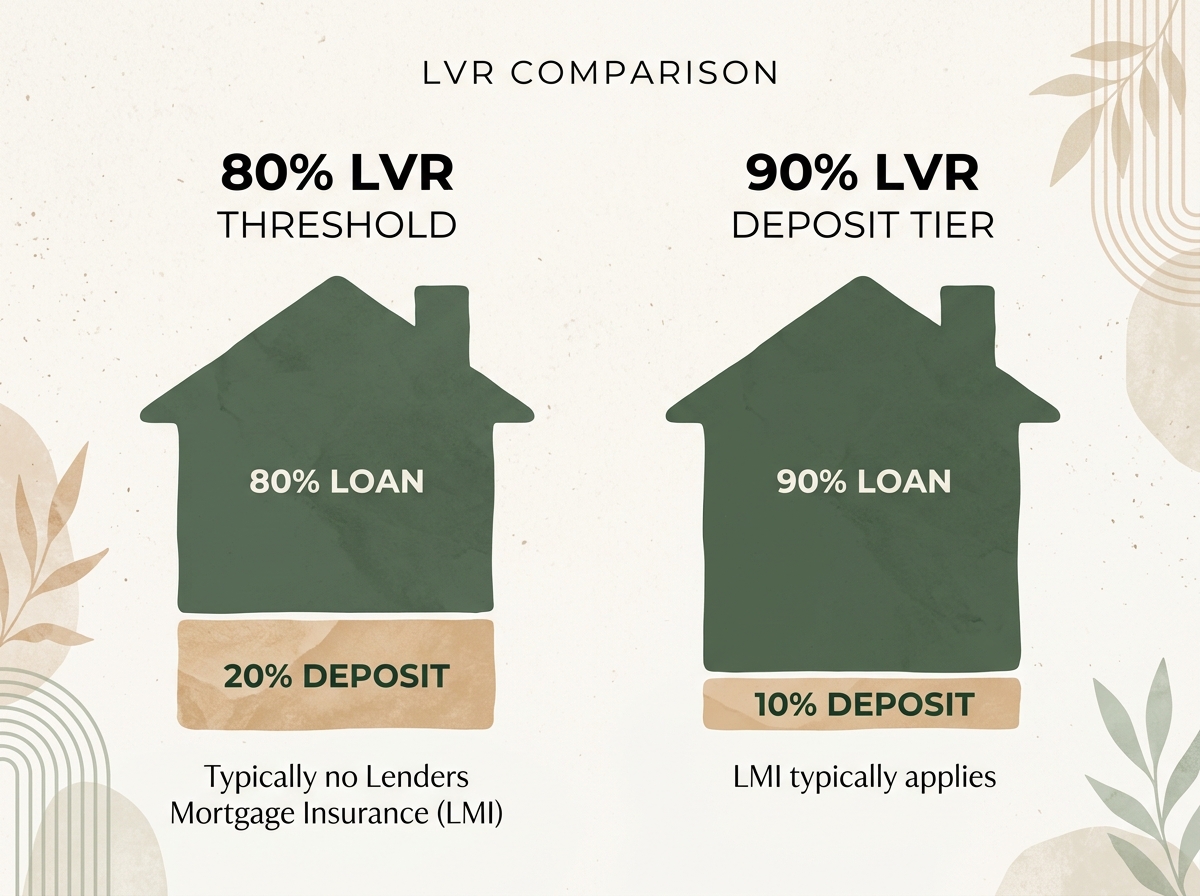
Loan-to-Value Ratio (LVR) represents the mortgage debt expressed as a percentage of the lender’s professional security valuation. In Australia, the standard benchmark is 80% LVR (requiring a 20% deposit). Borrowing above 80% triggers mandatory Lenders Mortgage Insurance (LMI)—a one-off premium that protects the lender (not the borrower) against default loss. While traditional advice urges avoiding LMI, strategic investors often choose to pay LMI (e.g. at 88%–90% LVR) to preserve liquid cash or enter growth markets earlier.
In property investment, capital efficiency is the foundation of portfolio scaling. How an investor allocates available equity and cash deposits between multiple property transactions dictates both long-term compounding growth and financial fragility. At the center of this decision sits the relationship between **Loan-to-Value Ratio (LVR)** and **Lenders Mortgage Insurance (LMI)**.
While owner-occupiers are routinely advised to save a strict 20% cash deposit to bypass mortgage insurance fees, property investors operate under a different set of financial mathematics in our investment finance framework. Understanding how LVR tiers function enables investors to deploy capital strategically rather than dogmatically.
Defining Loan-to-Value Ratio (LVR)
Your Loan-to-Value Ratio is calculated by dividing total mortgage debt by the bank’s formal valuation of the property security:
LVR = (Loan Amount / Bank Valuation) × 100
Crucially, the denominator is the lender’s formal security valuation, not necessarily your agreed purchase price. If you agree to purchase a property for $900,000, but the bank’s independent valuer appraises it at $870,000, the maximum 80% loan the bank will advance is $696,000 (80% of $870,000), leaving the buyer to cover the $24,000 valuation shortfall in cash.
How Lenders Mortgage Insurance (LMI) Operates
Lenders Mortgage Insurance is an underwriting policy underwritten by specialized insurance providers (predominantly Helia and QBE LMI in Australia) or self-insured by major banks. Key characteristics include:
- LMI Protects the Bank, Not You: If you default on your mortgage and the repossessed property is sold at a loss that fails to cover the outstanding debt, the LMI provider reimburses the bank. The insurer then retains full statutory legal rights to pursue you (the borrower) for the deficit.
- Capitalization of LMI: In most investment lending scenarios, the LMI premium does not need to be paid in upfront cash; it can be added (“capitalized”) on top of the mortgage loan up to a maximum ceiling (typically 90% base loan + LMI).
- Non-Refundable & Non-Transferable: If you refinance your loan to a different lender 18 months later, your previous LMI premium is forfeited, and you may be forced to pay LMI again if your new loan exceeds 80% LVR.
LMI Premium Tiers and Cost Scaling
LMI premiums are not linear—they scale exponentially as LVR increases and as total loan amounts rise. The following table illustrates typical estimated LMI costs on an $800,000 property purchase:
| LVR Tier | Required Deposit | Base Loan Amount | Estimated LMI Premium |
|---|---|---|---|
| 80% LVR | $160,000 (20%) | $640,000 | $0 (No LMI payable) |
| 85% LVR | $120,000 (15%) | $680,000 | $7,500 – $10,500 |
| 88% LVR | $96,000 (12%) | $704,000 | $12,000 – $16,000 |
| 90% LVR | $80,000 (10%) | $720,000 | $18,000 – $24,500 |
When calculating required upfront capital, always factor in government transfer costs. Use our breakdown of the full cost of buying an investment property to prevent unexpected cash shortfalls at settlement.
The Strategic Argument: When Paying LMI Makes Mathematical Sense
While paying $18,000 in non-refundable insurance seems counterintuitive, seasoned property investors evaluate LMI as a cost of speed and leverage:
Scenario: The Opportunity Cost of Saving a 20% Deposit
Imagine an investor with $100,000 in capital looking at an $800,000 dwelling in a market growing at 6% annually:
- Option A (Wait for 20% Deposit): The investor spends 2 years saving an extra $80,000 to reach an 80% LVR without LMI. Over those 24 months, the $800,000 property appreciates by 6% annually to $899,000—costing the investor $99,000 in lost capital appreciation to avoid an $18,000 LMI premium.
- Option B (Buy at 90% LVR Today): The investor enters the market immediately, capitalizes the $18,000 LMI into the loan, and secures the asset. The capital gain achieved in the first 6 months alone easily surpasses the insurance fee.
Tax Deductibility of LMI for Investors
Under Section 25-25 of the Income Tax Assessment Act 1997, LMI incurred on an investment property is classified as a borrowing expense. It is deductible against taxable income on a straight-line basis over 5 years (or the life of the loan, whichever is shorter). On a $15,000 premium, this yields a $3,000 annual tax deduction for 5 consecutive financial years.
If you already have equity built up in an existing home, you can often bypass LMI entirely by setting up separate loan splits. Read our detailed guide on using equity to buy an investment property.
Frequently Asked Questions: LVR and LMI Decisions
Can I get a refund on LMI if I pay off my loan early?
Historically, some insurers offered partial prorated LMI refunds if a mortgage was cleared within the first 12 to 24 months. However, in modern Australian banking practice, LMI premiums are almost universally 100% non-refundable from the date of loan settlement, regardless of whether you sell the asset or refinance 6 months later.
Does an 80% LVR guarantee automatic loan approval?
No. An 80% LVR simply satisfies the lender’s loan-to-value security risk threshold, removing the requirement for mortgage insurance. You must still independently demonstrate full repayment serviceability capacity under current stressed interest rate testing rules.
LMI Waiver Policies for Professional Niches
Certain high-income professional vocations qualify for LMI Waivers up to 90% LVR across major Australian banks:
- Medical Professionals: Doctors, surgeons, dentists, veterinarians, and optometrists frequently borrow up to 90% (and occasionally 95%) LVR with zero LMI required.
- Legal Professionals: Barristers, solicitors, and judicial officers with active practicing certificates.
- Accounting & Finance: Qualified CPAs, CAs, actuaries, and chartered financial analysts earning over established salary thresholds.
Primary Sources & Authority References
- ATO – Borrowing Expenses Deduction Rules (ITAA 1997 Section 25-25).
- Helia Insurance Pty Ltd – Lenders Mortgage Insurance Premium Schedule.
- ASIC MoneySmart – Understanding Loan-to-Value Ratios and LMI.