
Interest-Only vs Principal and Interest for Australian Property Investors: Complete Comparison
General Advice Warning: Loan repayment structures impact ongoing cash flow, taxation liabilities, and long-term interest charges. This explainer is educational in nature. Seek professional tax and mortgage broking advice before modifying loan terms.
Quick Answer
Interest-Only (IO) loans require the borrower to service only the monthly interest charges for an agreed period (typically 1 to 5 years), preserving monthly cash flow and leaving capital free to pay down non-deductible home debt. However, IO interest rates carry a 0.30% to 0.50% premium over Principal and Interest (P&I) rates, build zero property equity, and result in a substantial payment shock when the IO period expires and repayments reset over the compressed remaining loan term.
One of the most foundational structural choices an Australian property investor must make when setting up a mortgage facility is selecting between an **Interest-Only (IO)** loan and a traditional **Principal and Interest (P&I)** amortization schedule. This decision directly influences monthly cash flow, tax deductibility efficiency, and total interest paid over the life of the asset.
While paying down debt principal is instinctively preferred by conservative savers, property investing demands a strategic distinction between non-deductible “bad debt” (such as a private home loan) and tax-deductible “good debt” in our investment property loans guide. Deciding when to use IO terms requires analyzing both cash flow benefits and contractual reset risks.
How Principal & Interest and Interest-Only Loans Differ
The mechanics of the two repayment types represent contrasting financial philosophies:
- Principal and Interest (P&I): Every monthly repayment consists of two portions: the interest accrued on the remaining balance, plus a principal reduction payment that steadily repays the loan balance over the full 30-year contractual term.
- Interest-Only (IO): The borrower is billed purely for the interest incurred each month. The principal balance remains static throughout the agreed IO period (usually 1, 3, or 5 years). At the conclusion of this term, the loan automatically reverts to P&I repayments, amortizing the full original balance over the remaining term (e.g. 25 years).
Detailed Comparison: Financial and Cash Flow Metrics
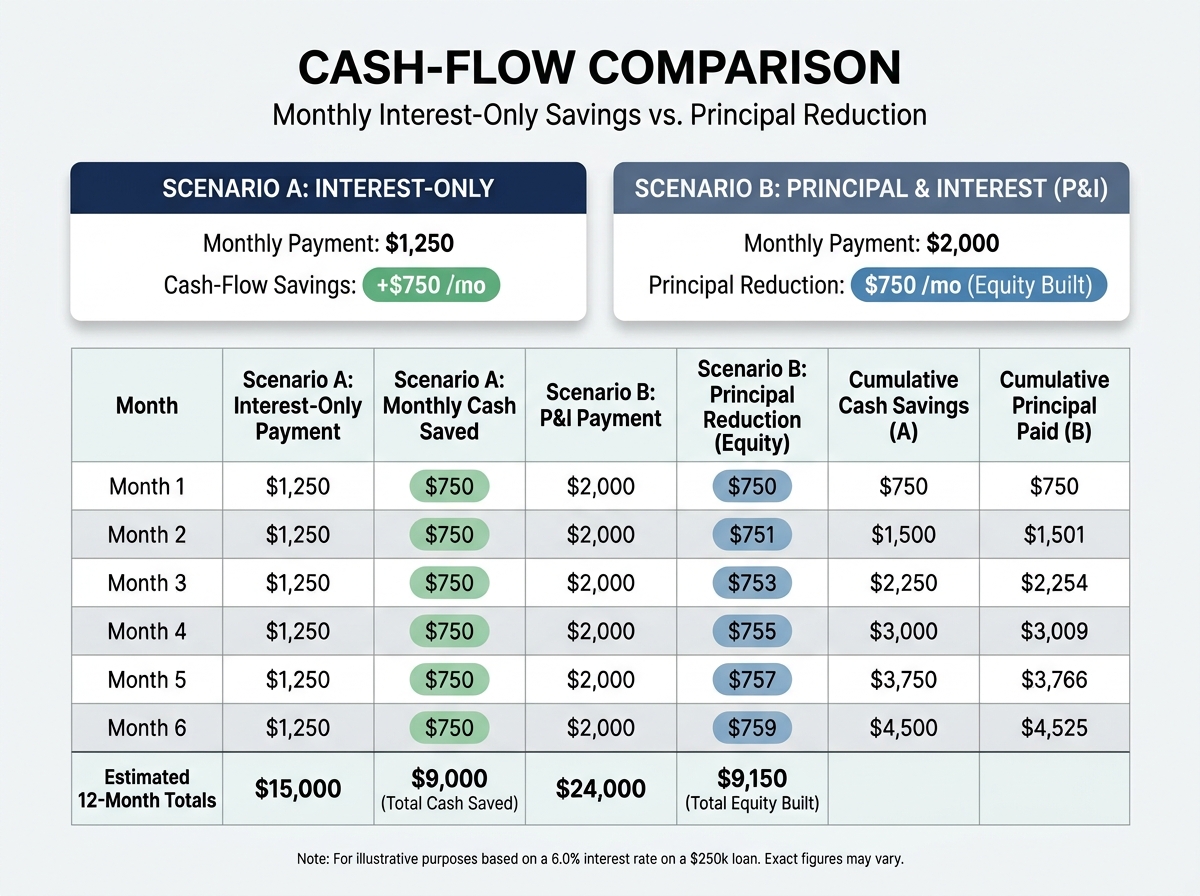
To evaluate the trade-offs, examine a typical $800,000 investment mortgage facility across both repayment models:
| Dimension | Principal and Interest (P&I) | Interest-Only (IO) – 5 Years |
|---|---|---|
| Contract Interest Rate | 6.15% p.a. | 6.55% p.a. (+0.40% premium) |
| Monthly Repayment (Years 1–5) | $4,874 / month | $4,367 / month (-$507/mo) |
| Principal Repaid in First 5 Years | ~$52,000 reduction | $0 (balance remains $800k) |
| Monthly Repayment at Year 6 Reset | $4,874 (steady) | $5,216 / month (+$849/mo jump) |
| Tax Deductibility Benefit | Deductible interest declines annually. | Deductible interest remains at maximum. |
Why Property Investors Prefer Interest-Only Structures
Despite paying a higher interest rate premium and building no equity, property investors routinely select IO terms for several compelling tactical reasons:
1. Capital Redirection to Non-Deductible Debt
If an investor carries an owner-occupied mortgage on their family home, every dollar spent paying down the investment property’s principal is a misallocated dollar. Interest on a private home is paid with after-tax dollars and is zero percent tax-deductible. By keeping the investment loan on Interest-Only, the investor preserves surplus monthly cash flow and funnels it into a 100% offset account against their private home mortgage, saving non-deductible interest far faster.
2. Tax-Deductible Holding Costs
Because interest incurred on money borrowed to purchase income-producing real estate is tax-deductible under ATO rules, keeping the loan balance high preserves maximum deductible interest expenses. Learn how this impacts overall tax positioning in our guide on negative gearing explained.
3. Cash Flow Flexibility and Buffers
Lower mandatory monthly payments provide financial breathing room during tenant vacancy periods, property maintenance repairs, or broader interest rate hiking cycles.
The Hidden Risks: The “IO Expiry Cliff”
While IO loans offer immediate liquidity benefits, they contain structural financial hazards:
- The Compressed Amortization Shock: When a 5-year IO term concludes, the bank does not recalculate repayments over 30 years; it amortizes the full loan balance over the remaining 25 years. As shown in the table above, monthly repayments abruptly jump from $4,367 to $5,216—an overnight cash outflow increase of $849 per month ($10,188 per year).
- Serviceability Re-Assessment on Extension: Investors often assume they can simply roll over their IO term for another 5 years. However, APRA prudential standards require banks to conduct a full serviceability credit re-assessment to extend an IO period. If interest rates have risen or your borrowing capacity has tightened, the bank may decline the extension, forcing you onto P&I repayments.
When applying for an IO loan, banks also stress-test your borrowing capacity on a P&I basis over the shorter remaining term. Review the assessment mechanics in our explainer on how serviceability is assessed for investment property loans.
Frequently Asked Questions: Managing Interest-Only Terms
What is the maximum interest-only period permitted in Australia?
Most Australian residential lenders permit consecutive interest-only terms up to a cumulative maximum of 5 years. Some non-bank institutions and private wealth divisions offer 10-year interest-only periods for high-net-worth investors, subject to stringent borrowing capacity reviews and lower maximum LVR ceilings (often capped at 70% to 75%).
How does an offset account work with an interest-only loan?
An offset account functions identically on an interest-only facility as it does on principal and interest. 100% of the cash balance sitting in the offset account is subtracted from the outstanding loan principal before monthly interest is calculated. For example, if you hold an ,000 IO loan with ,000 in a linked offset account, you are charged interest on only ,000, lowering your monthly cash outflow while maintaining full liquidity.
Can I switch from Principal & Interest back to Interest-Only later?
Yes, but switching an existing P&I loan to an Interest-Only structure requires a formal credit variation or product switch application. The bank will treat this as a new credit assessment and stress-test your household income under APRA guidelines before approving the conversion.
Strategic Summary: How to Choose
Align your loan repayment structure with your broader financial asset allocation:
- Select Interest-Only If: You have an existing non-deductible home loan to pay off first, value maximum tax deductibility, or require maximum cash flow flexibility during portfolio accumulation.
- Select Principal & Interest If: You have completely cleared your private home debt, wish to pay the lowest available interest rate, and prioritize debt reduction and equity buildup for eventual retirement.
Primary Sources & Authority References
- ASIC MoneySmart – Interest-Only Home Loans: Risks and Choices.
- APRA – Macroprudential Measures: Monitoring Interest-Only Lending.
- ATO – Rental Properties and Deductible Interest Expenses Guide.