Capital Gains Tax (CGT) on Australian Investment Property: The 50% Discount and Cost Base Rules
General Advice Warning: Capital Gains Tax (CGT) calculations depend on ownership structures, individual marginal tax brackets, and meticulous record keeping. This guide provides general educational explanations. Consult an accredited tax accountant before disposing of property assets.
Quick Answer
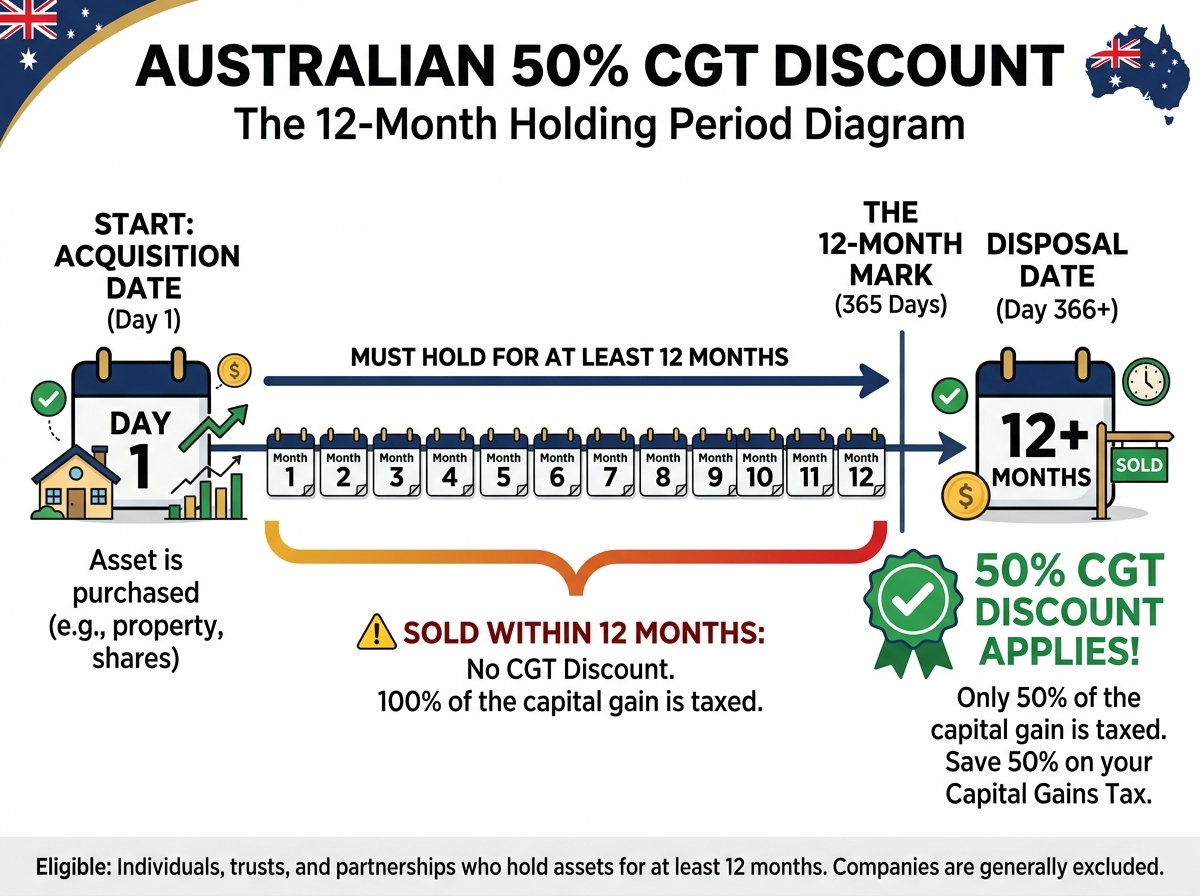
Capital Gains Tax (CGT) is the tax paid on the net financial profit realized when you sell an Australian investment property. CGT is not a separate tax rate; the net capital gain is added directly to your assessable income in the tax year the contract is signed. Crucially, if an individual or trust owns the property for at least 12 consecutive months, they qualify for the 50% CGT discount—meaning only half of the capital gain is subject to income tax.
The primary strategic objective of investing in Australian residential real estate is long-term capital compounding. However, the final financial scorecard of your property journey is determined upon disposal, when the Australian Taxation Office (ATO) assesses **Capital Gains Tax (CGT)** under Division 102 of the *Income Tax Assessment Act 1997*.
Many investors mistakenly assume that CGT is a flat, uniform percentage or that tax is assessed upon settlement day. In reality, CGT liability is governed by contractual dates, ownership structures, and five distinct elements of the **CGT cost base** in our property investor tax guides. Understanding these rules ensures investors legally minimize tax liabilities upon exit.
The 12-Month Rule and the 50% General CGT Discount
Introduced in September 1999 following the Ralph Report, the **50% general CGT discount** is the single most powerful tax concession available to Australian property investors:
- The 12-Month Requirement: If you hold an investment property for at least 12 consecutive months between the initial purchase contract exchange date and the sale contract exchange date, you are entitled to a 50% discount on the net capital gain.
- Eligibility by Entity: The 50% discount is available to individual taxpayers and discretionary/family trusts. In contrast, corporate company structures (Pty Ltd) receive 0% CGT discount (paying a flat 25% or 30% company tax rate on 100% of the gain). Complying Self-Managed Super Funds (SMSFs) receive a one-third (33.33%) discount, paying an effective 10% tax rate.
The Critical Contract Date Trap (Exchange vs Settlement)
One of the most dangerous traps in Australian property tax planning involves the timing of contract execution:
Under Section 104-10 of the ITAA 1997 (CGT Event A1), the CGT event occurs on the date the contract of sale is signed and exchanged, NOT on the date the property legally settles.
For example, if you enter into a contract to sell an investment property on 28 June 2026 with a 60-day settlement concluding on 28 August 2026, the entire capital gain must be declared in the 2025/2026 financial year, even though you did not receive a single dollar of settlement proceeds until the following financial year!
Mastering the CGT Cost Base: The 5 Essential Elements
You only pay CGT on your *net capital gain* (Capital Proceeds minus Reduced Cost Base). Maximizing your legal cost base directly shrinks your tax bill. The ATO defines five distinct cost base elements:
| Cost Base Element | Eligible Expenditures Included | Documentation Required |
|---|---|---|
| 1. Acquisition Price | The original contract purchase price paid for the asset. | Purchase contract & settlement statement. |
| 2. Incidental Purchase Costs | State stamp duty, conveyancing legal fees, buyers agent fees, loan application fees, building & pest inspection invoices. | Invoices from solicitor, revenue office, and buyers agent. |
| 3. Capital Improvements | Structural renovations: kitchen remodel, new roof, swimming pool, bathroom addition (not regular repairs). | Builder contracts, council approvals, itemized trade receipts. |
| 4. Title Defense Costs | Legal expenses incurred to defend or establish legal title to the property. | Legal invoices. |
| 5. Disposal Costs | Selling agent commissions, professional marketing/styling fees, auctioneer fees, discharge of mortgage fees. | Selling agency settlement adjustment ledger. |
Buyers agent advocacy fees form a legitimate part of the second element of costs; review standard fee benchmarks in our guide on buyers agent fees explained.
The Depreciation Clawback: Adjusting the Cost Base
There is a vital catch regarding building write-off deductions. If you claimed Division 43 Capital Works deductions (typically 2.5% per annum on the construction cost of the building) during your holding period, the ATO requires you to reduce your CGT cost base by the cumulative total of Division 43 deductions claimed.
If you claimed $40,000 in building write-offs over 10 years, your cost base is reduced by $40,000, which increases your eventual capital gain by that same amount. However, because that capital gain subsequently qualifies for the 50% CGT discount, you effectively claimed deductions against ordinary income at 100% while paying back the clawback at an effective 50% rate—a highly advantageous structural tax arbitrage.
Explore ongoing annual deductions in our companion guide on negative gearing explained.
Worked Numerical Example: Calculating Net CGT
Consider an investor selling an established house after an 8-year holding period:
- Contract Sale Price: $1,200,000
- Less Selling Agent & Marketing Costs: $28,000 → Net Proceeds: $1,172,000
- Original Purchase Price (Element 1): $700,000
- Original Stamp Duty & Conveyancing (Element 2): $35,000
- Capital Renovation (Element 3): $45,000
- Less Division 43 Depreciation Claimed: −$20,000
- Adjusted CGT Cost Base: $700,000 + $35,000 + $45,000 − $20,000 = $760,000
- Gross Capital Gain: $1,172,000 − $760,000 = $412,000
- Apply 50% General CGT Discount: $412,000 × 50% = $206,000 Net Taxable Capital Gain
This $206,000 is added to the investor’s assessable income for that financial year and taxed at prevailing marginal tax rates.
Remember to factor in state land tax liabilities during the ownership period; see our analysis of land tax for investors by state.
Frequently Asked Questions: Capital Gains Tax
Can I offset past capital losses against a property capital gain?
Yes. If you carry forward accumulated capital losses from prior financial years (such as losses realized on shares or cryptocurrency), the ATO requires you to subtract those capital losses from your gross capital gain before applying the 50% CGT discount.
Does the 6-year main residence exemption apply to investment properties?
Under Section 118-145 of the ITAA 1997, if a property was originally established as your genuine primary place of residence (PPOR) before being rented out, you can continue treating it as your main residence for CGT purposes for up to 6 years while earning rental income, potentially exempting 100% of the capital gain from taxation.
Primary Sources & Authority References
- ATO – Guide to Capital Gains Tax 2026 (Nat 4151).
- Income Tax Assessment Act 1997 – Division 102 & Division 115 (CGT Discount).
- ATO – Taxation Determination TD 2006/78: Cost Base Elements.