Stamp Duty for Investors by State: Rates and Surcharges in NSW, VIC, QLD, WA & SA
General Advice Warning: Stamp duty (transfer duty) rates and threshold brackets are established by individual state and territory revenue offices and are subject to legislative amendment. Calculations in this guide reflect prevailing standard investment schedules. Confirm figures with your conveyancer prior to exchange.
Quick Answer
Stamp duty (officially termed transfer duty) is a mandatory state government tax levied on property acquisitions, payable upon or prior to settlement. Stamp duty varies dramatically across jurisdictions: on an $800,000 investment purchase, transfer duty ranges from approximately $28,000 in Queensland to over $44,000 in Victoria. Investors receive zero first home buyer concessions and must pay duty in cash or fund it via borrowed equity splits.
When acquiring Australian real estate, **stamp duty (transfer duty)** represents the largest single upfront expense after your deposit. Levied by state and territory governments, stamp duty is a progressive transaction tax calculated on the greater of the contract purchase price or the unencumbered market value of the property.
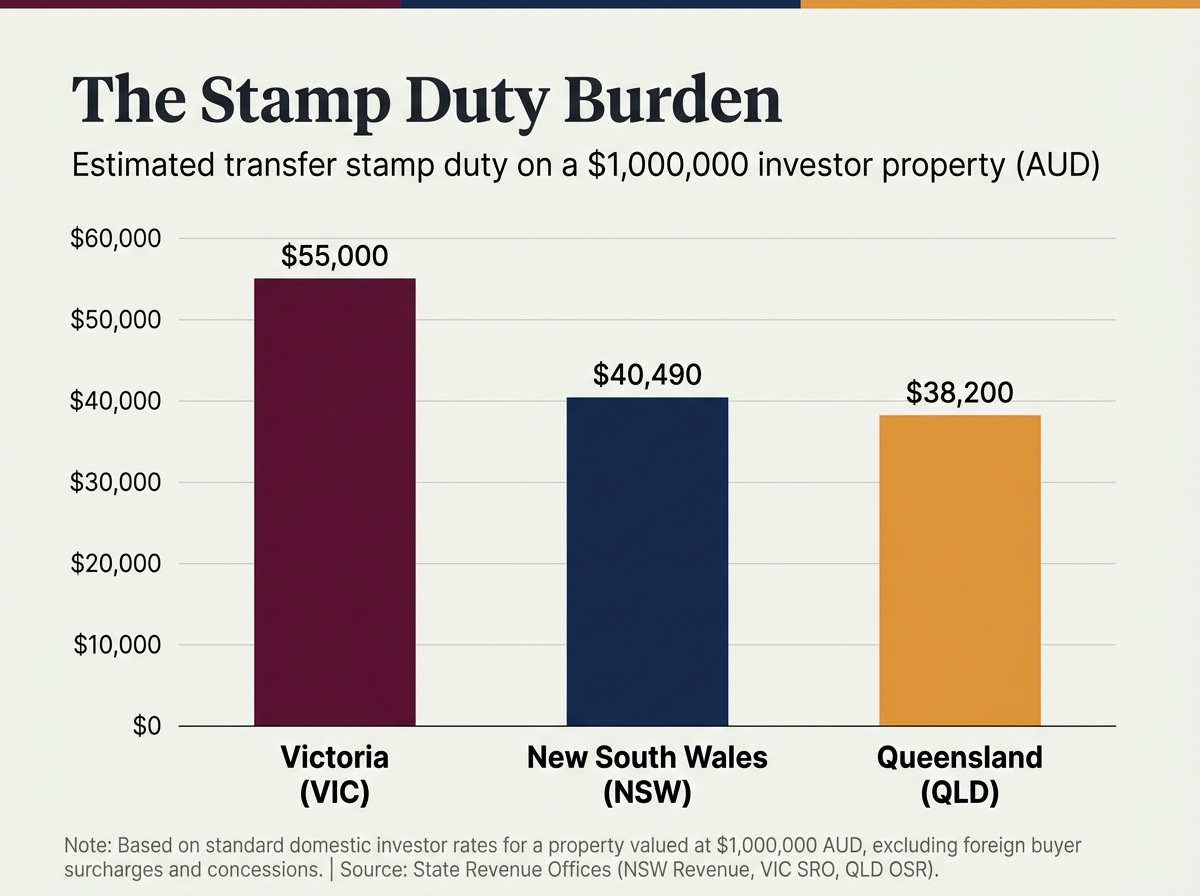
For residential investors operating across borders, stamp duty creates stark geographic friction in our investor purchase guides. Because property legislation is state-based, the duty payable on the exact same purchase price can vary by over $16,000 depending on which side of a state border the property sits.
State-by-State Duty Comparison: The $800,000 Benchmark
To visualize the statutory differences across Australia, examine the transfer duty levied on an identical $800,000 established residential investment purchase:
| State / Territory | Revenue Authority | Duty Payable on $800k | Effective Duty Rate |
|---|---|---|---|
| Victoria (VIC) | State Revenue Office Victoria | $44,070 | 5.51% (Highest) |
| South Australia (SA) | RevenueSA | $38,830 | 4.85% |
| New South Wales (NSW) | Revenue NSW | $30,760 | 3.85% |
| Western Australia (WA) | RevenueWA | $32,415 | 4.05% |
| Queensland (QLD) | Queensland Revenue Office | $28,025 | 3.50% (Lowest) |
| Tasmania (TAS) | State Revenue Office Tasmania | $31,935 | 3.99% |
Payment Timelines: When is Stamp Duty Legally Due?
Investors must be prepared to disburse stamp duty funds within strictly mandated statutory deadlines:
- NSW, VIC, QLD, WA, SA: In electronic settlement transactions conducted via PEXA, stamp duty is verified prior to settlement and disbursed automatically at the exact moment of legal settlement from the buyer’s source account.
- Statutory Fallback Deadlines: In New South Wales, the legal deadline is within 3 months of contract signing. In Victoria, duty must be paid within 30 days of settlement. In Queensland, it is payable within 30 days of unconditional exchange. Late payment incurs punitive compound interest penalties from state revenue offices.
Foreign Purchaser Additional Duty Surcharges
If you are not an Australian citizen or permanent resident, every mainland Australian state levies severe Foreign Purchaser Additional Duty (FPAD) surcharges:
- NSW, VIC, QLD, WA: Levy an additional 7% to 8% surcharge on top of standard stamp duty rates.
- On an $800,000 purchase in New South Wales, a foreign buyer pays $30,760 standard duty plus a $64,000 surcharge (8%), totaling an astounding $94,760 in upfront state taxes.
When modeling your required capital reserves, factor in all legal and conveyancing expenses. Use our comprehensive itemization in the full cost of buying an investment property.
Tax Treatment: Can You Deduct Stamp Duty?
A common mistake among first-time investors is attempting to claim stamp duty as an immediate tax deduction against annual salary in their tax return. Under ATO ruling guidelines:
- Stamp duty is a capital acquisition expense. It is 0% tax-deductible against ongoing rental income.
- Instead, the full stamp duty amount is added directly to your Capital Gains Tax (CGT) cost base under Element 2 (incidental acquisition costs). This reduces your taxable capital gain when you eventually sell the property in the future.
Learn how cost bases are structured in our detailed guide on Capital Gains Tax (CGT) cost base rules.
Financing Stamp Duty: Avoiding LVR Blowouts
Because banks will not advance loan funds exceeding 80% to 90% LVR against the target property security, stamp duty cannot be added directly to the main purchase mortgage without triggering mortgage insurance penalties. Investors manage this by funding duty via cash savings or releasing usable home equity through a separate loan split. Read our loan structuring guide on using equity to buy an investment property.
Detailed State Surcharge Schedules: Commercial & Residential Splits
Understanding statutory brackets across each individual state enables precise budgeting:
- New South Wales Premium Transfer Duty: In NSW, standard residential transfer duty applies up to $3,505,000. For properties valued above this premium threshold, residential purchasers pay an elevated rate of $176,810 plus $7.00 for every $100 exceeding $3,505,000.
- Queensland Tiered Concessions: Queensland maintains five marginal rate brackets ranging from 1.5% on amounts up to $5,000, rising to 5.75% for values over $1,000,000. Unlike southern states, Queensland’s general duty schedule remains among the most competitive in the nation for entry-level investors.
- Western Australia Concessional Brackets: Western Australia levies transfer duty starting at 1.9% on transactions up to $120,000, scaling to a top marginal rate of 5.15% on property values exceeding $500,000.
Can Stamp Duty Be Deferred or Paid in Installments?
Unlike personal income tax debt which can sometimes be structured into payment arrangements with the ATO, state revenue offices do not permit installment plans or deferrals on property stamp duty for standard residential acquisitions. In electronic conveyancing platforms (PEXA), the electronic settlement workspace will physically fail to execute if cleared stamp duty funds are not pre-authorized and verified in the electronic trust account prior to the scheduled settlement hour.
Frequently Asked Questions: Stamp Duty for Investors
Do property investors qualify for stamp duty concessions or exemptions?
Almost never. First Home Buyer Assistance Schemes (FHBAS) that provide full or partial stamp duty exemptions across Australian states are strictly restricted to owner-occupiers who reside in the property for at least 12 consecutive months. Investment purchases pay full, un-concessioned general transfer duty from dollar one.
Does buying off-the-plan save stamp duty?
In Victoria, off-the-plan duty concessions allow buyers to pay duty on the land value only (prior to building construction). However, in recent years, eligibility for off-the-plan concessions has been predominantly restricted to owner-occupiers, meaning residential property investors generally pay duty on the full contract price.
Primary Sources & Authority References
- Revenue NSW – Transfer Duty Rate Schedules and Calculation Tables.
- State Revenue Office Victoria – Land Transfer Duty Calculator & Guidance.
- Queensland Revenue Office – Transfer Duty Rates for Residential Investment.