

Home › Investment finance
Investment Property Loans in Australia: A Plain-English Guide
By Alyssa John • Published: November 2025 • Last Reviewed: October 2026
General Advice Warning: This guide provides general education only and does not constitute personal financial, credit, legal, or tax advice. Consider your financial position and speak with an accredited professional before making property investments.
Mortgage finance shapes an Australian property investment strategy far more than most first-time investors anticipate. The terms, structure, and leverage of your lending facilities determine your total borrowing capacity, ongoing holding costs, tax deductibility, and portfolio risk tolerance.
How Australian Lenders Assess Investor Borrowing Capacity
When assessing an investment loan application, Australian banks and non-bank lenders evaluate two primary underwriting pillars: serviceability (whether your verifiable net surplus cash flow covers loan repayments) and Loan-to-Value Ratio (LVR) (the ratio of mortgage debt against the property’s security valuation).
To establish serviceability, lenders apply conservative underwriting assumptions:
- Discounted Rental Income: Lenders typically “shade” gross rental income by 20% to 30% (counting only 70% to 80% of anticipated rent) to buffer against vacancies, council rates, and maintenance.
- The APRA Serviceability Buffer: The Australian Prudential Regulation Authority (APRA) mandates that lenders evaluate repayment capacity at a minimum test rate of 3.00 percentage points above the current contract rate. If your actual loan rate is 6.20%, your serviceability is assessed at 9.20%.
- Living Expense Scrutiny: Lenders benchmark declared living expenses against the Household Expenditure Measure (HEM) and inspect bank transaction feeds for discretionary commitments.
Core Loan Features for Property Investors
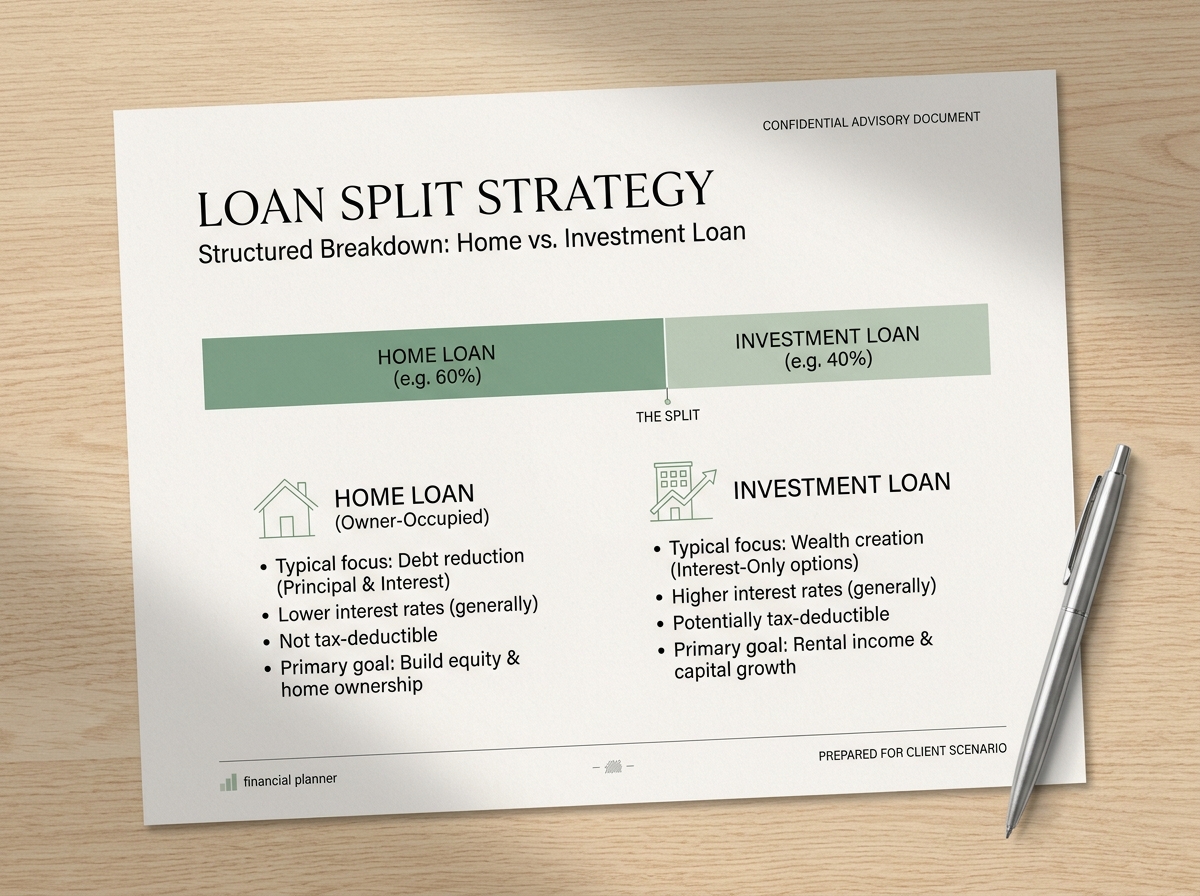
Managing investment finance requires separating private home debt from deductible investment debt:
| Loan Structure | Mechanism | Tax & Strategic Value |
|---|---|---|
| 100% Offset Account | Cash deposit account linked to the loan reducing charged interest daily. | Keeps capital liquid while preserving total deductible loan balance for future investment transitions. |
| Interest-Only (IO) Terms | Borrower services only accrued monthly interest for 1 to 5 years. | Maximises monthly cash flow; enables extra surplus funds to pay down non-deductible home debt. |
| Separate Loan Splits | Borrowing deposit and costs as a distinct loan against existing home equity. | Maintains clean paper trails for the ATO; completely avoids dangerous cross-collateralisation. |
All Articles in Investment finance
Explore our detailed research articles and deep-dive explainers in this category:
How Serviceability is Assessed for Investment Property Loans in Australia
Lender net income shading, living expense benchmarks (HEM), and borrowing capacity calculations.
Published: 08 Feb 2026 • Read Full Guide →
The APRA Serviceability Buffer Explained: How the 3% Assessment Test Impacts Borrowing
Why banks test your repayments at 8.5%+ and how this macroprudential hurdle impacts investor borrowing power.
Published: 22 Feb 2026 • Read Full Guide →
LVR and LMI Explained for Property Investors: 80% Thresholds and Capital Efficiency
Calculating Loan-to-Value ratios, LMI capitalization, and when paying LMI is mathematically justifiable.
Published: 05 Mar 2026 • Read Full Guide →
Interest-Only vs Principal and Interest for Australian Property Investors: Complete Comparison
Cash-flow flexibility vs long-term amortization hurdles: when to select IO terms and how to plan for the reset.
Published: 19 Mar 2026 • Read Full Guide →
Using Equity to Buy an Investment Property: How Usable Equity and Loan Splits Work
Tapping existing property wealth without cross-collateralisation using standalone investment loan splits.
Published: 04 Apr 2026 • Read Full Guide →