
Land Tax for Investors by State: Thresholds, Surcharges and Portfolio Aggregation Rules
General Advice Warning: Land tax legislation, statutory thresholds, and surcharge rates are governed by state revenue offices and undergo regular legislative modification. Calculations in this guide reflect general educational models. Consult a registered property tax specialist to structure multi-asset holdings.
Quick Answer
Land tax is an annual state government wealth tax levied on the total combined unimproved land value (excluding the building structure) of all taxable property you own in a single state above that jurisdiction’s statutory threshold. Your primary home (principal place of residence) is completely exempt. Crucially, land tax is state-ringfenced: owning three properties across three different states allows you to claim three separate tax-free thresholds, whereas owning all three in one state aggregates your land values into high progressive tax brackets.
When property investors calculate ongoing holding expenses, they routinely budget for council rates, landlord insurance, property management commissions, and loan interest. However, as an investment portfolio scales beyond a single dwelling, **state land tax** frequently emerges as the largest, most aggressive recurring holding liability on the balance sheet.
Because land tax is progressive—with marginal tax rates climbing sharply as accumulated land value increases—failing to understand portfolio aggregation rules can devastate net rental cash flows in our property investor legislation guides. Understanding state thresholds allows investors to structure acquisitions intelligently across jurisdictional borders.
What is Land Tax and How is It Assessed?
Land tax is an annual levy calculated on the **unimproved land value** of taxable real estate owned as of midnight on a statutory assessment date (midnight 31 December in NSW, Victoria, and WA; midnight 30 June in Queensland and SA):
- Unimproved Land Value: Land tax assesses only the statutory land component, completely excluding the dwelling, improvements, renovations, or landscaping. This value is determined annually by state Valuers-General using mass statutory valuation algorithms.
- The Principal Residence Exemption: Your family home (Principal Place of Residence or PPOR) is universally exempt from land tax across all Australian states, regardless of how much the land is worth.
- Aggregation Within a State: If an individual owns three investment properties in New South Wales, Revenue NSW adds together the unimproved land values of all three properties into a single combined assessment total.
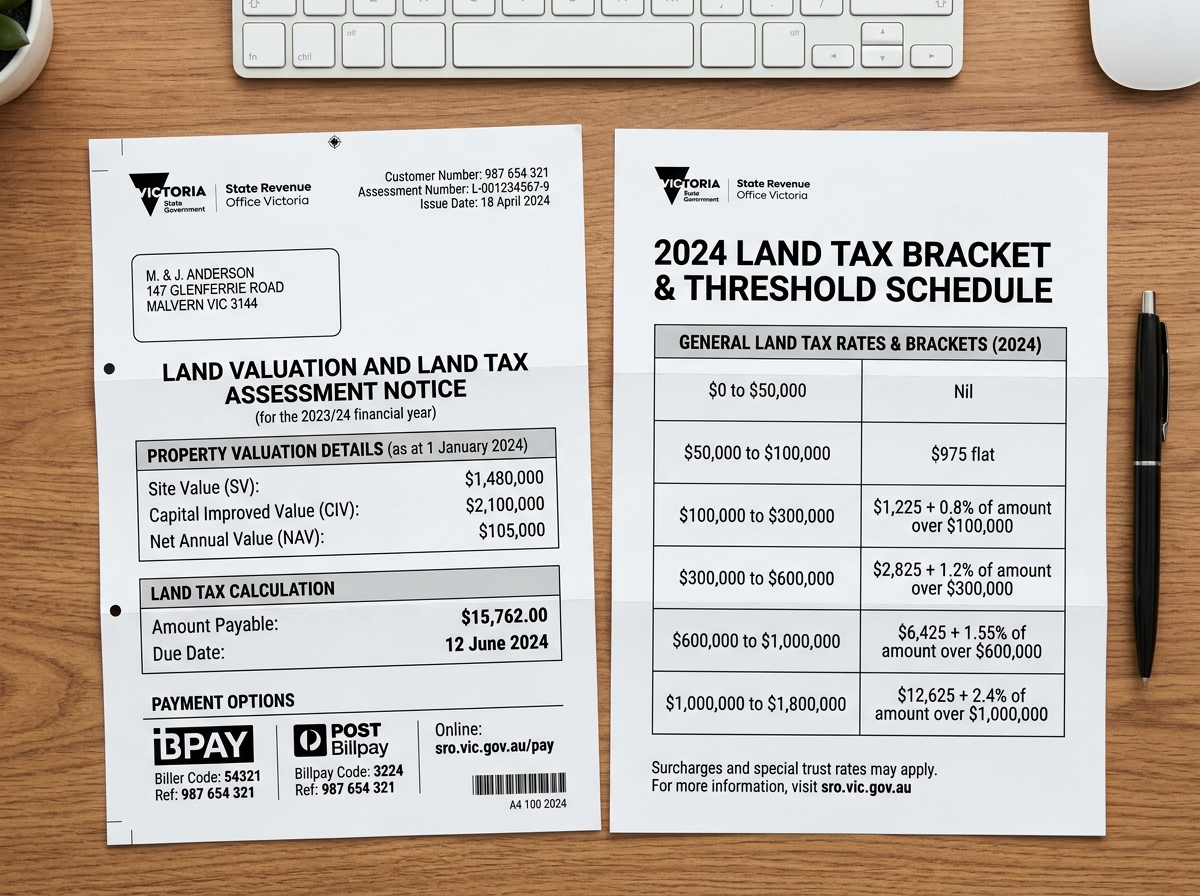
State-by-State Thresholds and Rate Comparison
Statutory tax-free thresholds and rate brackets diverge dramatically between Australian jurisdictions:
| State | Tax-Free Threshold (General) | Marginal Rate Above Threshold | Premium / Surcharge Bracket |
|---|---|---|---|
| New South Wales (NSW) | $1,075,000 (Indexed annually) | $100 + 1.6% of excess | 2.0% above premium threshold ($6.5M+). |
| Victoria (VIC) | $50,000 (COVID Debt Levy regime) | $500 base + progressive 0.2%–2.65% | Lowest threshold in Australia; catches nearly all investors. |
| Queensland (QLD) | $600,000 (Individual) | $500 + 1.0% to 1.75% progressive | Surcharge above $5M land value. |
| Western Australia (WA) | $300,000 | Progressive rates from 0.05% to 2.67% | Top bracket kicks in above $11M land value. |
| South Australia (SA) | $534,000 (Indexed) | 0.5% up to 2.4% top marginal rate | Strict trust aggregation rules apply. |
Compare initial acquisition stamp duties across these same jurisdictions in our guide on stamp duty for investors by state.
The Power of Interstate Border Diversification
Because land tax is administered independently by each state government, **there is currently no national aggregation of land values**. This statutory separation creates a major strategic advantage for multi-property investors:
Scenario: The Aggregation Trap vs The Border Strategy
Consider an investor acquiring three residential investment properties, each possessing a statutory unimproved land value of $500,000 (Total Portfolio Land Value: $1,500,000):
- Strategy 1 (All 3 in NSW): Total land value ($1,500,000) exceeds the $1,075,000 NSW threshold by $425,000. At 1.6%, the annual land tax liability is approximately $6,900 every single year.
- Strategy 2 (Spread Across NSW, QLD, and WA):
- NSW Property ($500k land): Under the $1,075,000 threshold → $0 Land Tax
- QLD Property ($500k land): Under the $600,000 threshold → $0 Land Tax
- WA Property ($500k land): Pays modest tiered duty → ~$450 Land Tax
- Total Combined Annual Land Tax: $450/year (Saving $6,450 every year!)
By diversifying acquisitions across state lines, the investor legally utilizes three separate tax-free thresholds, preserving thousands of dollars in annual cash flow.
Tax Deductibility of Land Tax for Investors
Under ATO guidelines, annual state land tax paid on an income-producing residential property is **100% tax-deductible** as an ongoing holding expense in the financial year the assessment is incurred. Learn how this interacts with your annual tax return in our guide to negative gearing explained.
Trust Surcharges: The Holding Entity Dilemma
While holding investment properties in a discretionary trust offers excellent asset protection and estate planning advantages, most states penalize trusts with punitive land tax schedules:
- In New South Wales, discretionary trusts receive $0 tax-free threshold, paying a flat 1.6% land tax from dollar one of land value.
- In Victoria, trusts pay a special trust surcharge of up to 0.375% on land values between $25,000 and $250,000, and 0.611% above $250,000.
Always model land tax implications with your conveyancer and accountant before deciding on an ownership entity. Review complete upfront acquisition figures in our breakdown of the full cost of buying an investment property.
Statutory Valuation Objections: Contesting Inflated Land Values
Because state Valuers-General determine land values using mass computer modeling rather than individual site visits, statutory unimproved valuations are frequently inaccurate. If you believe your land tax assessment is excessive:
- Inspect Your Land Valuation Notice: Review the statutory site valuation notice issued by your state revenue office or valuer-general.
- Gather Local Valuation Evidence: Collate evidence of recent unimproved land sales in your immediate street, noting topography challenges, easements, or contamination that restrict land utility.
- Lodge a Formal Statutory Objection: In all Australian states, taxpayers possess a strict 60-day window from the date of the assessment notice to lodge a formal written objection. Successful objections can permanently reduce your annual recurring land tax baseline.
Frequently Asked Questions: State Land Tax
Can a landlord pass land tax charges onto a residential tenant?
No. Under residential tenancies legislation in every Australian state and territory, landlords are strictly prohibited from passing land tax costs directly onto residential tenants. Land tax is an exclusive statutory liability of the property owner.
What is the difference between Council Rates and Land Tax?
Council rates are levied by local municipal governments (councils) to fund community infrastructure such as roads, garbage collection, and parks. Land tax is an entirely separate state government revenue tax levied directly by state revenue offices into general state treasuries.
Primary Sources & Authority References
- Revenue NSW – Land Tax Management Act 1956 Guidelines.
- State Revenue Office Victoria – Land Tax Rates and Threshold Schedules.
- ATO – Deductibility of State Land Tax on Rental Properties (TR 97/7).