

The APRA Serviceability Buffer Explained: How the 3% Assessment Test Impacts Borrowing
General Advice Warning: This explainer reviews macroprudential regulatory policy established by APRA. It is educational information and does not constitute credit assistance or financial advice. Individual lender credit assessment policies are subject to regulatory updates.
Quick Answer
The APRA serviceability buffer is a mandatory macroprudential rule requiring Australian banks to test whether borrowers can afford loan repayments if interest rates rise by at least 3.00 percentage points above their actual loan contract rate. Introduced to safeguard financial system stability against rate shocks, this 3% stress test reduces borrowing capacity by approximately 25% to 30% compared to unbuffered underwriting, creating a significant barrier for property investors.
Few regulatory mechanisms exert as powerful an influence over Australian property values and borrower purchasing power as the serviceability buffer set by the Australian Prudential Regulation Authority (APRA). While central bank cash rate decisions make newspaper headlines, APRA’s mortgage lending directives quietly control the credit spigots that determine how much money Australian households can borrow.
For residential property investors, understanding the mechanics of the 3.0 percentage point buffer is vital. It explains why a household with pristine credit and substantial surplus income can find their borrowing capacity capped far below their everyday budgeting expectations in today’s investment finance environment.
Historical Context: How the Buffer Evolved
APRA’s macroprudential serviceability rules have adjusted dynamically in response to monetary policy and credit growth cycles:
- December 2014: APRA introduced a benchmark serviceability interest rate floor of at least 7.00% across all Australian banks, accompanied by a 2.0% buffer above loan contract rates, designed to cool double-digit investor credit expansion.
- July 2019: In an easing cycle, APRA removed the static 7.00% floor, allowing banks to set their own interest rate floors while raising the required buffer to 2.50 percentage points above actual contract rates.
- October 2021: Amid surging post-pandemic housing price inflation and rapidly increasing debt-to-income (DTI) ratios exceeding 6x, APRA increased the minimum buffer to 3.00 percentage points. Despite aggressive subsequent cash rate tightening by the RBA, APRA has maintained this 3.00% buffer to insulate banks against default risks.
How the 3% Buffer Works in Practice
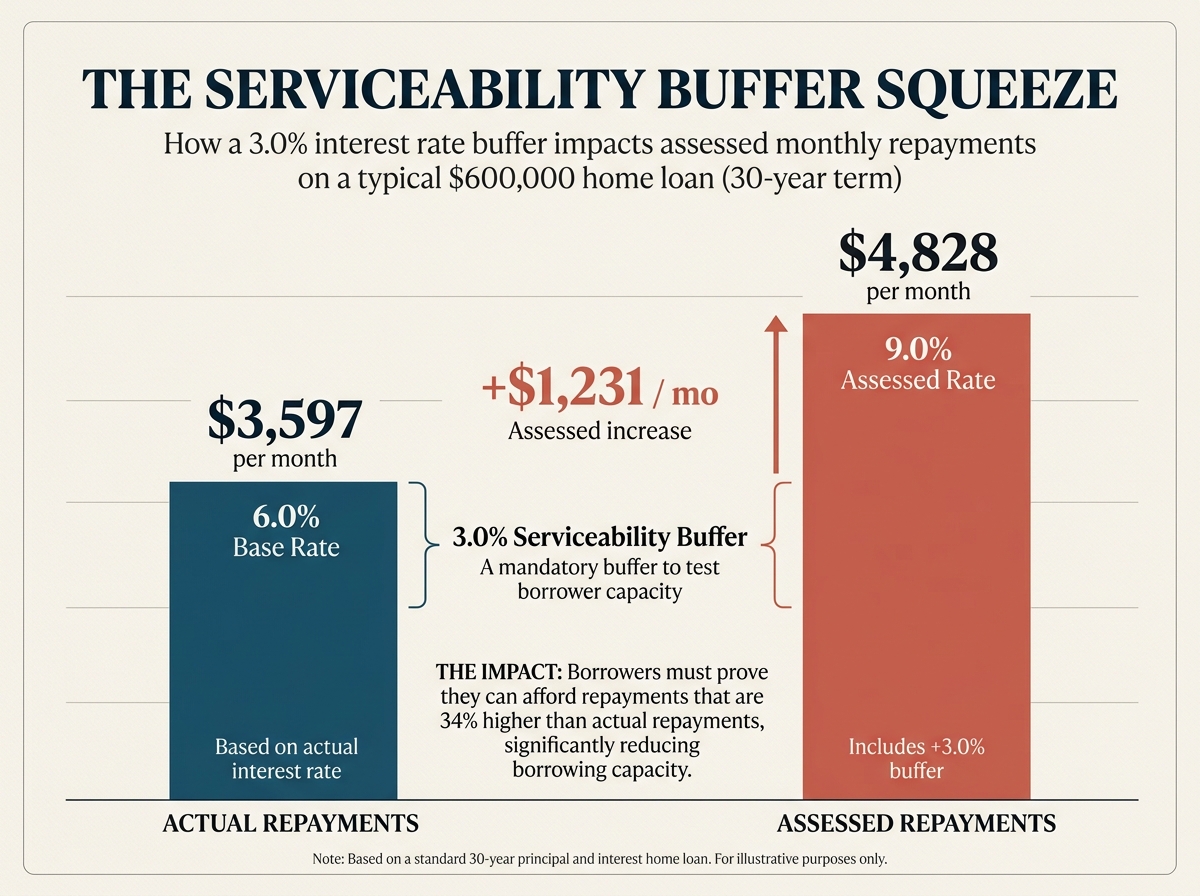
The mathematical operation of the buffer is straightforward but punitive. When an applicant applies for a mortgage, the lender calculates repayment obligations using an assessment interest rate:
Assessment Rate = Actual Contract Interest Rate + 3.00% APRA Buffer
Consider the real-world impact on a prospective $1,000,000 investment borrowing facility:
| Metric | Actual Contract Loan Terms | APRA Assessed Loan Terms |
|---|---|---|
| Interest Rate Applied | 6.25% (Standard Investor Variable) | 9.25% (Assessment Stress Rate) |
| Monthly Repayment (30-yr P&I) | $6,157 / month | $8,227 / month |
| Annual Repayment Commitment | $73,884 / year | $98,724 / year |
| Serviceability Cash Flow Gap | — | +$24,840 / year ($2,070/mo) phantom stress |
Even though the investor’s bank account will only be debited $6,157 each month, the bank’s credit algorithm demands proof that the borrower’s surplus income can absorb an additional $2,070 per month ($24,840 annually) in mortgage payments. If the household budget cannot accommodate this buffer, the loan is declined.
This stress test interacts directly with overall borrowing limits; examine the full underwriting criteria in our breakdown of how serviceability is assessed for investment loans.
The Compounding Impact on Multi-Property Investors
While home buyers feel the buffer on a single mortgage, property investors with existing portfolios experience a severe compounding debt effect:
When an investor applies for a loan on their second or third property, the bank does not merely stress-test the new proposed loan. The lender applies the 3.00% stress buffer across all existing mortgage commitments held across the investor’s entire portfolio unless those existing loans are held with other lenders that provide verifiable fixed rates.
For an investor with an existing $700,000 home loan and an $800,000 investment mortgage, the bank assesses the total $1,500,000 in existing debt at 9.0%+, dramatically inflating the perceived monthly debt liability and destroying borrowing power for subsequent purchases.
This reality makes debt structuring crucial. Investors often weigh the benefits of interest-only loans to preserve cash flow against higher assessment rates; read our analysis of interest-only vs principal and interest for investors.
APRA vs The Reserve Bank: Policy Divergence
Investors frequently ask why APRA does not lower the buffer when the Reserve Bank of Australia (RBA) raises or lowers interest rates. To understand this dynamic, review how the RBA cash rate affects property investors.
The RBA’s mandate is macroeconomic stability (controlling inflation and maintaining full employment). In contrast, APRA’s sole statutory mission is prudential safety—ensuring that banks remain solvent and resilient against severe recessionary shocks. APRA views the 3.00% buffer as an insurance policy against unexpected financial hardship, unemployment spikes, or future rate volatility.
Frequently Asked Questions: The APRA Serviceability Buffer
Does the APRA buffer apply to commercial property loans?
No. APRA’s mandatory 3.00% serviceability stress test is strictly legislated for residential mortgage lending provided to households and individuals. Commercial property lending, corporate facilities, and business loans are assessed under distinct commercial credit risk matrices that prioritize lease covenant strength and weighted average lease expiries (WALE).
Will APRA reduce the buffer if the property market softens?
APRA reviews macroprudential policy settings quarterly, assessing credit growth, household debt-to-income (DTI) metrics, and mortgage arrears rates. While APRA has the statutory authority to reduce the buffer to 2.5% or 2.0% during severe economic downturns, it has historically maintained the 3.0% buffer to ensure the banking system retains resilience against systemic shocks.
Non-Bank Lenders and the “Refinancing Exception”
In response to mortgage prisoners trapped by the 3% buffer, APRA issued regulatory guidance allowing banks to apply a streamlined 1.00% serviceability buffer for borrowers seeking a like-for-like refinance of an existing loan, provided they have a clean repayment history. However, this concession strictly applies to refinancing without increasing debt—it does not expand borrowing capacity for new property acquisitions.
Additionally, certain non-bank lenders that do not hold ADI licenses operate outside APRA’s direct prudential jurisdiction. While they still adhere to ASIC’s responsible lending laws, some non-banks apply alternative buffers (such as 2.0% or 2.5%), offering an alternative avenue for high-surplus investors constrained by APRA-regulated banks.
Primary Sources & Authority References
- APRA – Information Paper: Macroprudential Policy Framework (2021/2026).
- Reserve Bank of Australia (RBA) – Bulletin: The Impact of Lending Buffers on Borrowing Capacity.
- Australian Treasury – Review of the Australian Prudential Regulation Authority.