
Negative Gearing Explained for Australian Property Investors: Rules, Mechanics and ATO Limits
General Advice Warning: Australian taxation legislation is complex and subject to statutory interpretation. The calculations and rules discussed in this guide are general educational illustrations under current ATO rulings. Always consult a registered tax agent (CPA or CA) to model your personal tax liabilities.
Quick Answer
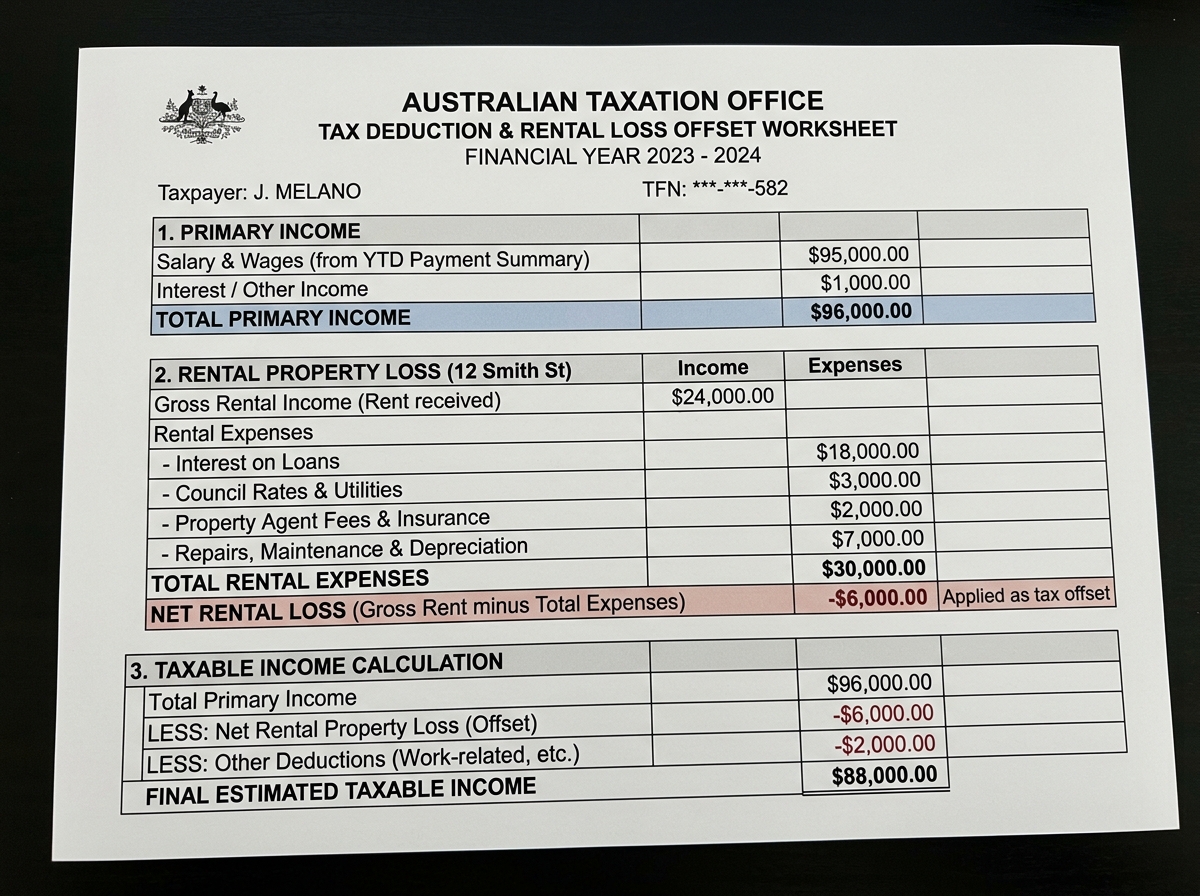
Negative gearing occurs when the allowable deductible expenses of owning an Australian investment property (mortgage interest, council rates, insurance, repairs, and non-cash depreciation) exceed the gross rental income it generates. Under Australian Taxation Office (ATO) rules, this net rental loss can be deducted directly against your other taxable income (such as PAYG salary), reducing your total income tax liability for the financial year.
Few economic mechanisms in Australia evoke as much fierce political debate, media commentary, and investor interest as **negative gearing**. To critics, it is a controversial tax concession that distorts housing affordability; to property investors, it is a legitimate tax principle that cushions holding costs while building long-term wealth.
Yet, behind the political rhetoric lies a fundamental accounting reality: negative gearing is not an independent tax scheme, but the natural application of general tax law in our Australian property tax guides. Section 8-1 of the Income Tax Assessment Act 1997 allows taxpayers to deduct expenses incurred in gaining assessable income. Understanding how this operates in practice ensures investors manage cash flow effectively rather than losing money for the sake of a tax refund.
The Three Gearing States Defined
In Australian real estate terminology, “gearing” simply refers to borrowing money to purchase an investment asset. A property exists in one of three gearing states:
- Positively Geared: Gross rental income exceeds all deductible operating expenses (including mortgage interest). The property produces a net pre-tax profit, which is added to your taxable income and taxed at your marginal rate.
- Neutrally Geared: Rental income exactly equals the total deductible expenses. The property operates at cash-flow breakeven with zero taxable profit or loss.
- Negatively Geared: Total deductible expenses exceed gross rental income, resulting in a net tax loss that can be offset against other income.
Itemising Allowable ATO Rental Deductions
To determine whether your property is negatively geared, the ATO allows landlords to deduct legitimate ownership expenses:
| Deduction Category | Eligible Expenses Included | Key ATO Rule / Restriction |
|---|---|---|
| Loan Interest (Cash) | Interest charged on loan balance used for purchase/repairs. | Only interest is deductible; loan principal repayments are 0% deductible. |
| Council & Water Rates (Cash) | Municipal council general rates and annual water service charges. | Tenant-consumed water usage is only deductible if paid by the landlord. |
| Property Management (Cash) | Agent commissions, letting fees, advertising, lease preparation. | Fully deductible in the year incurred. |
| Repairs & Maintenance (Cash) | Restoring damaged fixtures to original working order (e.g. fixing a burst pipe). | Initial repairs on pre-existing purchase defects must be capitalized into the CGT cost base. |
| Tax Depreciation (Non-Cash) | Division 43 Capital Works (2.5%/yr on build) & Division 40 Plant & Equipment. | Requires an official schedule prepared by an accredited Quantity Surveyor. |
How you structure your loan plays a pivotal role in deductible interest volume. Read our comprehensive analysis of interest-only vs principal and interest loans.
Worked Numerical Example: The Real After-Tax Cash Flow
To understand the financial mechanics, examine a salaried professional earning $150,000 per year (marginal tax rate of 37% + 2% Medicare Levy = 39% marginal tax rate) who owns an investment property:
1. The Property Cash Flow Ledger
- Gross Rental Income ($600/week × 52): $31,200
- Mortgage Interest (Loan balance $700,000 @ 6.25% IO): $43,750
- Operating Cash Expenses (Rates, strata, insurance, management): $7,200
- Non-Cash Tax Depreciation (Quantity Surveyor schedule): $8,000
- Total Allowable Deductions: $43,750 + $7,200 + $8,000 = $58,950
2. Calculating the Tax Deduction and Refund
- Net Taxable Rental Loss: $31,200 (Income) − $58,950 (Expenses) = −$27,750 Net Loss
- Original Taxable Salary: $150,000
- Adjusted Taxable Salary ($150,000 − $27,750): $122,250
- Tax Saved / Refund Generated: $27,750 × 39% = $10,822 Tax Refund!
3. Real Out-of-Pocket Cash Position
Notice the critical distinction between paper accounting and real cash flow:
- Actual Cash Outflow: $43,750 (Interest) + $7,200 (Operating Expenses) = $50,950
- Actual Cash Inflow: $31,200 (Rent) + $10,822 (ATO Tax Refund) = $42,022
- True Net Out-of-Pocket Holding Cost: $50,950 − $42,022 = $8,928 per year ($171 per week).
The investor is funding $171 per week out of pocket to control a $750,000 capital asset. If the property appreciates at an average of 5% annually ($37,500/year), the capital gain easily outpaces the holding deficit.
When you eventually sell the property, that capital gain is subject to taxation; explore how the 50% discount applies in our guide to Capital Gains Tax (CGT) on Australian property.
The Golden Rule: Never Invest Solely for a Tax Deduction
A dangerous misconception among novice property buyers is that generating a tax deduction is inherently profitable. A tax deduction at a 39% marginal rate simply means the federal government reimburses you 39 cents for every dollar you lose. You still lose the remaining 61 cents.
Negative gearing is only a sensible financial strategy if the underlying residential property generates capital appreciation that substantially exceeds your cumulative net holding losses over your investment timeframe.
Investors must also factor in transaction expenses during acquisition. Review our comprehensive checklist on the full cost of buying an investment property.
Managing Cash Flow with an PAYG Withholding Variation
Waiting until October each year to lodge a tax return and receive an $11,000 lump-sum refund can strain household cash flow during the year. Under Section 15-15 of Schedule 1 to the Taxation Administration Act 1953, property investors can lodge an ITWV (PAYG Withholding Variation) application with the ATO.
Once approved, the ATO instructs your employer to reduce the amount of income tax withheld from your regular fortnightly payslip, distributing your anticipated $11,000 refund as approximately $420 in additional take-home pay every fortnight to service holding expenses in real time.
Frequently Asked Questions: Negative Gearing Rules
Can I claim negative gearing on a holiday home used by my family?
Under strict ATO guidelines, deductions are only allowable for periods when the property is genuinely available for rent at commercial market rates. If you or your family utilize the property for private holidays during peak seasons, deductions must be proportionately reduced.
Are travel expenses to inspect an interstate investment property deductible?
No. In 2017, the Commonwealth Government legislated an explicit ban on residential landlords claiming travel, accommodation, or airfare deductions for inspecting or maintaining residential investment properties.
Primary Sources & Authority References
- Australian Taxation Office (ATO) – Rental Properties Guide: Deductions & Negative Gearing.
- ATO – Taxation Ruling TR 97/23: Deductions for Repairs.
- Income Tax Assessment Act 1997 – Section 8-1: General Deductions.