
How the RBA Cash Rate Affects Australian Property Investors: Transmission and Strategy
General Advice Warning: Central bank cash rate movements and macroeconomic monetary policy commentary represent general educational analysis. Interest rate forecasts are inherently speculative. Consult a licensed financial planner before adjusting debt strategies.
Quick Answer
The Reserve Bank of Australia (RBA) cash rate is the benchmark overnight money market interest rate that anchors all retail borrowing costs in Australia. When the RBA adjusts the cash rate, commercial banks pass the change directly onto Standard Variable Rate (SVR) mortgages within days. For investors, each 25-basis-point (0.25%) cash rate increase increases annual holding costs by roughly $2,000 per $800,000 in debt while simultaneously eroding new borrowing capacity by approximately 2.5% to 3.0%.
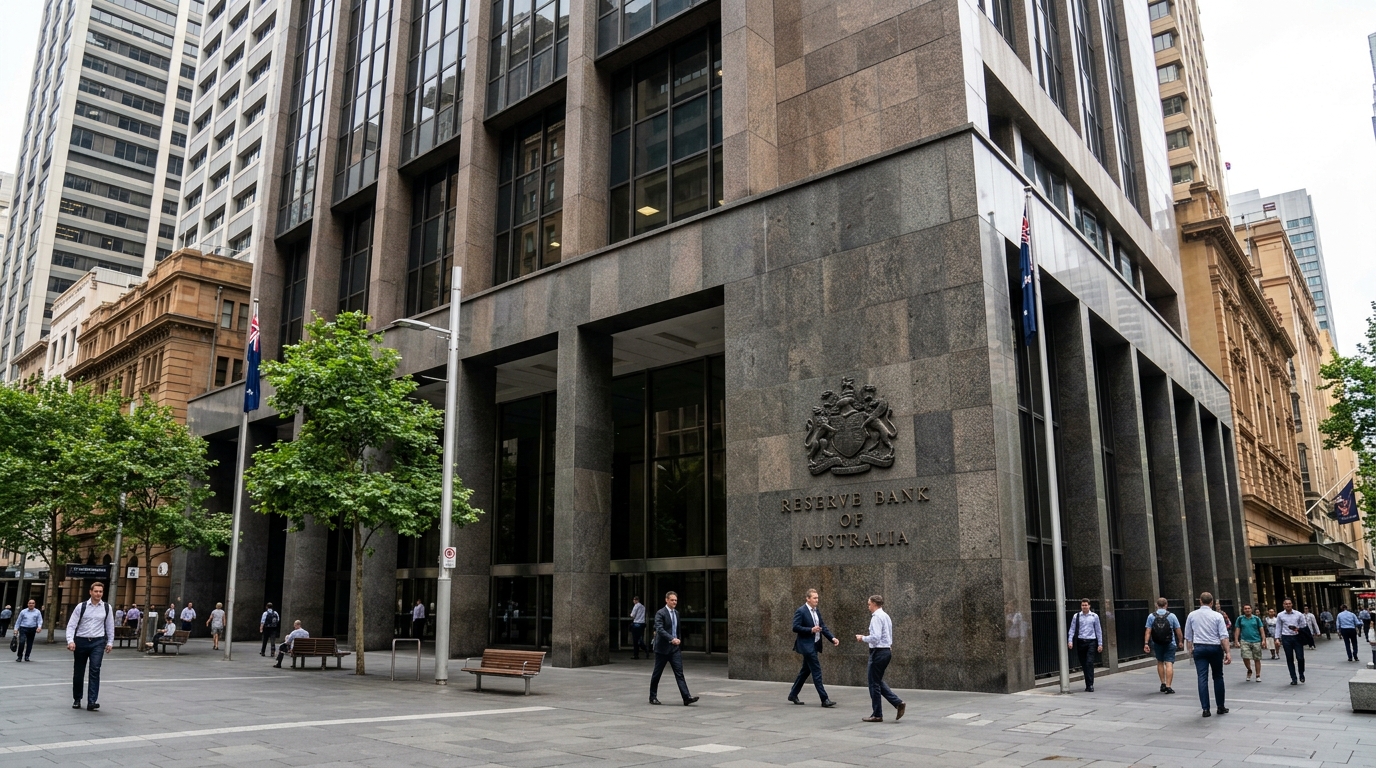
The Reserve Bank of Australia (RBA) operates eight scheduled monetary policy meetings each year from its headquarters in Martin Place, Sydney. While central bank communications focus on headline Consumer Price Index (CPI) inflation and national labour market statistics, RBA interest rate announcements reverberate directly into the bank accounts of every residential property investor in the country.
Because the vast majority of Australian residential mortgages are issued on floating variable interest rates, the Australian economy exhibits one of the fastest monetary policy transmission mechanisms in the developed world. Understanding how the cash rate flows through bank balance sheets, serviceability algorithms, and asset valuations is crucial for navigating our property market economic indicators.
The Monetary Policy Transmission Mechanism
The official cash rate represents the interest rate that commercial banks pay to borrow and lend unsecured overnight funds between themselves in the interbank market. The transmission of an RBA rate decision follows a rapid four-stage sequence:
- RBA Board Determination: The Board announces whether the target cash rate is increased, reduced, or held steady.
- Wholesale Bank Funding Costs: Commercial banks adjust their prime lending rates, wholesale debt issuances, and deposit rates to reflect the new target.
- Retail Mortgage Repricing: Within 24 to 72 hours, Australia’s major banks (Commonwealth Bank, Westpac, NAB, ANZ) and non-bank lenders announce matching adjustments to their Standard Variable Rates (SVRs).
- Cash Flow Realignment: Borrowers experience adjusted monthly interest debits on their mortgages, altering household disposable surplus cash flow.
Direct Cash Flow Impact on Property Portfolios
To quantify the financial reality, examine the holding cost changes across different mortgage debt brackets resulting from a 100-basis-point (1.00%) cumulative rate tightening cycle:
| Total Investor Debt Balance | +0.25% Rate Hike (Monthly) | +0.50% Rate Hike (Monthly) | +1.00% Rate Hike (Annual Impact) |
|---|---|---|---|
| $500,000 Loan | +$104 / month | +$208 / month | +$5,000 / year |
| $1,000,000 Loan | +$208 / month | +$417 / month | +$10,000 / year |
| $2,000,000 Portfolio | +$417 / month | +$833 / month | +$20,000 / year |
For an investor carrying a $1,500,000 portfolio on interest-only terms, a 100-basis-point rate hike demands an additional $15,000 in gross annual holding interest. While this expense is tax-deductible under ATO rules, the cash shortfall must still be funded from real-world cash flow reserves.
Learn how rising interest costs interact with tax returns in our explainer on negative gearing mechanics and ATO limits.
The Secondary Shock: Borrowing Capacity Destruction
While existing holding costs increase immediately, the impact on new borrowing capacity is even more dramatic. Because APRA requires banks to stress-test prospective borrowers at contract rate + 3.00%, every single rate hike increases the assessment benchmark:
- When mortgage contract rates rise from 3.00% to 6.25%, the bank assessment stress test rate jumps from 6.00% to 9.25%.
- Economic modeling shows that every 100-basis-point (1.00%) increase in mortgage rates reduces maximum household borrowing capacity by roughly 10% to 11%.
- A family that could borrow $1,100,000 under a low-rate environment finds their maximum borrowing capacity compressed to approximately $780,000 under a tightened regime.
To examine the regulatory mechanics of stress buffers, read our detailed analysis of the APRA serviceability buffer explained.
How the Cash Rate Drives the Broader Property Cycle
The transmission mechanism links monetary policy directly to dwelling values across three distinct phases:
Phase 1: Rate Tightening (Cooling & Volume Contraction)
As the RBA raises rates, borrowing capacity falls, auction clearance rates drop, and buyer urgency wanes. Highly leveraged sub-markets (such as prestige housing or investor-heavy unit blocks) experience price consolidation or downward adjustments. Conversely, highly constrained rental markets experience rental inflation as prospective home buyers are pushed into renting.
Phase 2: The Pause (Market Stabilization)
Once the RBA halts rate hikes, consumer sentiment stabilizes. Buyers adjust to the new interest rate baseline, vendor expectations align with reality, and transaction volumes begin to recover.
Phase 3: Rate Easing (Reflation & Credit Expansion)
When inflation returns to the RBA’s 2%–3% target band and the central bank begins cutting rates, borrowing capacity expands rapidly. Pent-up buyer demand returns to auction floors, driving price acceleration across capital city markets.
For tactical guidance on managing loan structures across cycles, explore our comparison of interest-only vs principal and interest loans.
Historical RBA Easing and Tightening Cycles: Key Lessons for Investors
Examining historical monetary policy cycles over the past two decades provides valuable perspective for residential property investors:
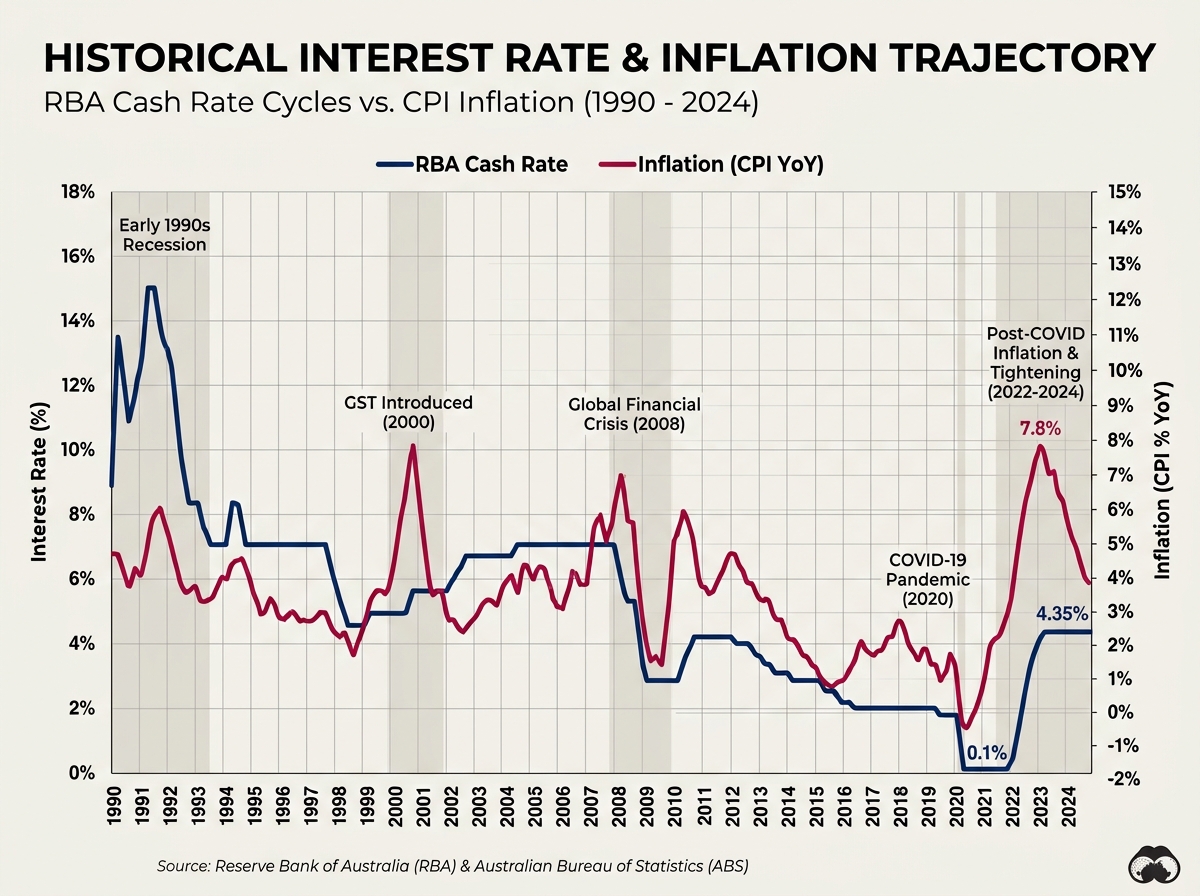
- The 2008 Global Financial Crisis (Rapid Easing): In response to the global credit crisis, the RBA slashed the official cash rate by 425 basis points from 7.25% down to 3.00% within nine months. Australian dwelling values recovered quickly, supported by massive credit expansion and government first home buyer stimulus.
- The 2011–2016 Mining Investment Transition: As the mining investment boom unwound, the RBA steadily reduced rates from 4.75% to 1.50%, initiating an explosive five-year property bull market across Sydney and Melbourne.
- The 2022–2024 Post-Pandemic Inflation Spike: Faced with inflation peaking at 7.8%, the RBA executed the fastest tightening cycle in modern Australian history, hiking the cash rate from 0.10% to 4.35% in just 18 months. While national property prices initially dipped 5% to 8%, extreme rental shortages and surging overseas migration subsequently drove values to new record highs.
The clear historical takeaway is that while interest rates drive cyclical fluctuations, structural housing shortages, demographic growth, and household income fundamentals ultimately dictate long-term capital preservation.
Frequently Asked Questions: The RBA Cash Rate
Why don’t fixed-rate loans protect investors completely?
While a fixed-rate loan locks your monthly repayments for an agreed term (typically 1 to 5 years), it merely delays the rate transmission. When the fixed term concludes, the loan automatically reverts to the prevailing Standard Variable Rate, triggering an immediate and steep payment shock if the RBA tightened during the holding window.
Can rents rise fast enough to offset RBA rate hikes?
In tightly held capital city markets with vacancy rates below 1.5%, strong rental demand allows landlords to pass through partial rate costs via annual rent increases. However, in balanced or oversupplied markets, asking rents are dictated by tenant wage growth and local housing supply, not by the landlord’s personal mortgage costs.
Primary Sources & Authority References
- Reserve Bank of Australia (RBA) – The Cash Rate Operational Framework & Meeting Minutes.
- RBA – Research Discussion Paper: The Monetary Policy Transmission Mechanism in Australia.
- Australian Treasury – Macroeconomic Forecasting & Interest Rate Impact Analysis.