
Buyers Agent Fees Explained: Fixed Fee vs Percentage Commission in Australia
General Advice Warning: Fee structures discussed here represent prevailing industry benchmarks across Australian capital cities. Agency fees are entirely negotiable and subject to individual commercial contracts. Always verify fee inclusions, gst components, and refund conditions before signing.
Quick Answer
Australian buyers agents typically charge between 1.5% and 2.5% (+ GST) of the final purchase price, or a flat fixed fee ranging from $9,000 to $25,000 depending on property value and service tier. Most agencies require an upfront engagement retainer of $1,500 to $4,000 (deducted from the final success fee). While percentage fees are common, fixed fees eliminate the inherent conflict where the agent earns higher pay if you purchase a more expensive property.
Engaging a professional property advocate is an investment in risk mitigation and negotiation leverage. However, because real estate fee structures in Australia are completely deregulated by state governments, buyers frequently encounter a wide spectrum of pricing models, terminology, and hidden cost clauses.
When selecting professional independent buyers agents, understanding how fee structures interact with advisor incentives is just as critical as evaluating the gross dollar figure. A fee structure should reward thorough due diligence and aggressive price negotiation, not merely speed of transaction.
The Standard Fee Components: Retainers and Success Fees
Professional buyer advocacy engagements almost universally consist of two distinct billing stages:
1. The Upfront Engagement Retainer
The engagement fee (also known as a commencement retainer) typically ranges between $1,500 and $4,000. This fee covers initial onboarding costs, establishing the property brief, running detailed analytical data reports, and conducting physical inspections during the first several weeks.
In almost all reputable agencies, this engagement retainer is credited against the final success fee upon contract exchange. However, if the client terminates the agreement or fails to purchase within the exclusivity period (usually 6 to 12 months), this retainer is strictly non-refundable to compensate the advocate for committed labour hours.
2. The Final Success Fee
The success fee constitutes the vast bulk of the advocate’s remuneration. It becomes legally payable upon unconditional exchange of contracts (or at settlement, depending on the agency contract terms). This fee is charged either as a fixed dollar amount or a percentage of the final purchase price.
Fixed Fee vs Percentage Commission: Detailed Comparison
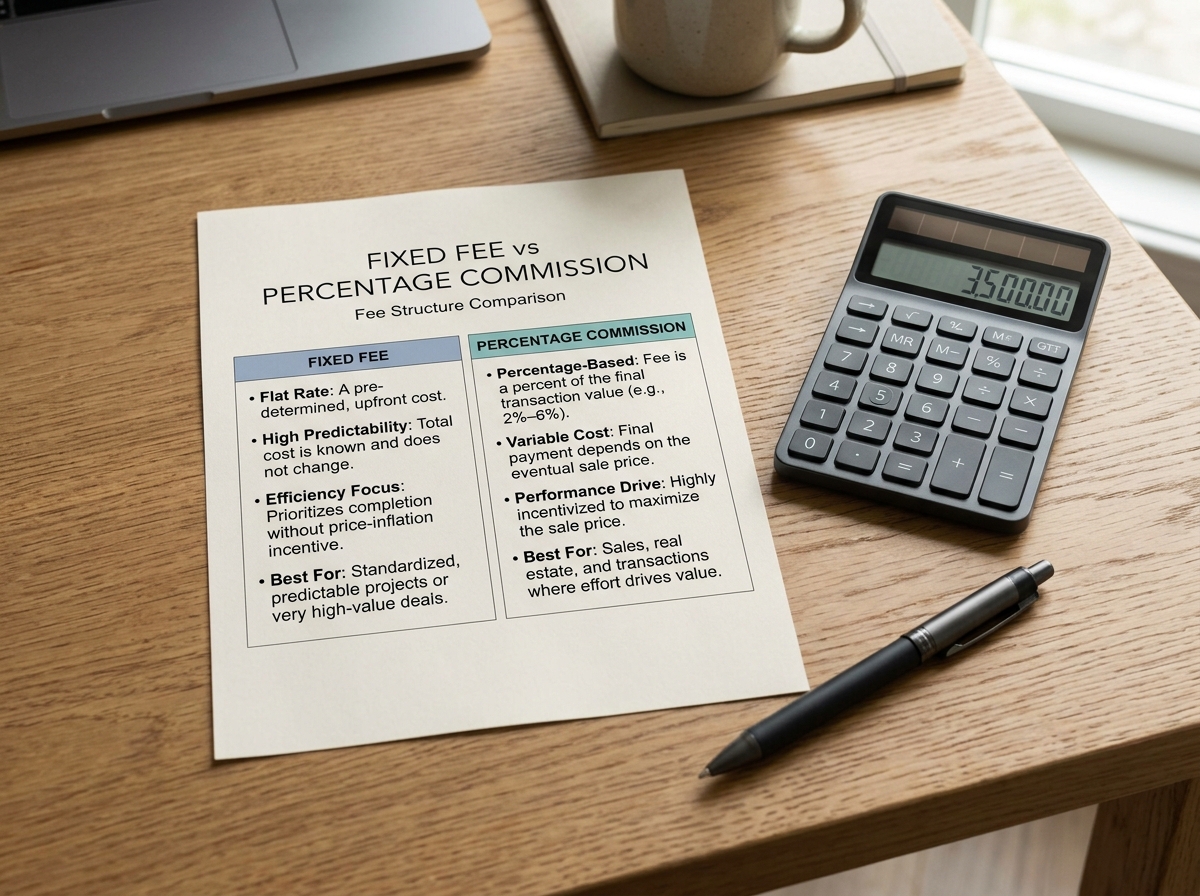
The debate between flat fixed fees and percentage commissions is central to evaluating advisor alignment:
| Dimension | Fixed Flat Fee Model | Percentage Commission Model |
|---|---|---|
| Cost Predictability | 100% transparent. You know exact fee before signing. | Variable. Scales upward with higher purchase price. |
| Incentive Alignment | Completely neutral. The advocate has zero incentive to recommend an overpriced asset. | Structural conflict: The agent earns a higher dollar return if you pay more for the property. |
| Typical Market Rates | $10,000 to $22,000 depending on price tier. | 1.5% to 2.5% + GST (e.g. $15,000–$25,000 on a $1M purchase). |
| Best Suited For | Investors who prioritize objective pricing and budget certainty. | Lower-tier properties where fixed fees represent too high a percentage. |
Tiered Fixed Fees: The Balanced Industry Standard
To resolve the percentage conflict while accounting for transaction complexity, many modern agencies utilize a tiered fixed fee schedule. Under this structure, fees are bracketed based on expected property price ranges:
- Sub-$750,000 Acquisitions: Fixed fee of approximately $11,000 + GST.
- $750,000 to $1,500,000 Acquisitions: Fixed fee of approximately $15,000 + GST.
- $1,500,000 to $2,500,000 Acquisitions: Fixed fee of approximately $20,000 + GST.
- Prestige Properties ($3M+): Custom bespoke engagement terms or 1.5% to 2.0% fee structures.
Because the fee is fixed within your pre-approved purchase bracket, the buyers agent remains motivated to negotiate the lowest possible purchase price without suffering a personal pay cut.
Partial Service and Specialist Engagement Fees
Investors do not always require full turnkey search services. Many agencies offer unbundled service tiers:
- Auction Bidding Only: If you have already inspected the property and conducted due diligence, an advocate can bid on your behalf to remove emotion. Standard fees range from $800 to $1,500 for auction attendance, plus a discretionary bonus of $1,000 to $2,000 if the property is secured under the hammer.
- Negotiation Only: If you have found a private treaty listing, the agent handles valuation benchmarking and negotiation strategy. Fees typically range between $3,000 and $7,000.
- Due Diligence Appraisals: Reviewing legal contracts, zoning overlays, and compiling comparable sales reports on client-found dwellings typically costs between $1,200 and $2,500 per asset.
When assessing overall transaction budgets, remember that buyers advocacy fees are only one component of your acquisition capital. Ensure you review the full cost of buying an investment property, factoring in conveyancing, loan establishment, and state transfer duties.
Are Buyers Agent Fees Tax-Deductible in Australia?
A frequent point of confusion among property investors is whether buyers agent fees can be claimed as an immediate tax deduction against annual salary income. Under Australian Taxation Office (ATO) ruling guidelines, the tax treatment depends on the asset’s purpose:
- Immediate Deduction (Section 8-1): Buyers agent fees are not immediately deductible as an ongoing holding expense (unlike property management fees or loan interest).
- Capital Gains Tax Cost Base: Because the fee is directly incurred in acquiring the capital asset, the entire fee is added to the property’s Capital Gains Tax (CGT) cost base under the third element of costs. This reduces your net taxable capital gain when you eventually sell the property in the future.
Beware of unvetted operators offering “free” advocacy services. Read our guide on buyers agent conflicts of interest to understand how two-tier marketing and developer kickbacks disguise commercial costs.
Key Contractual Clauses to Inspect
Before executing an agency agreement, inspect the fine print for these critical terms:
- Exclusivity Duration: Ensure the agreement does not lock you into exclusive representation for longer than 6 months without performance milestones.
- Post-Expiry Tail Clauses: Beware of clauses stating that if you buy any property introduced by the agent within 6 to 12 months after the contract ends, the full success fee remains payable.
- Incidental Expenses: Check whether pest inspections, strata report purchases, and title searches are included in the retainer or billed separately.
- Termination Terms: Look for mutual termination clauses allowing either party to exit with 14 days written notice if relationship alignment breaks down.
Primary Sources & Authority References
- Australian Taxation Office (ATO) – Capital Gains Tax Cost Base Elements (TR 95/35).
- ASIC MoneySmart – Working with Real Estate Agents and Fee Structures.
- Real Estate Institute of New South Wales (REINSW) – Buyers Agent Fee Transparency Guidelines.